#LoveYourEyes in Practice: Drishti Before Darshan Takes Eye Care to India’s Places of Worship
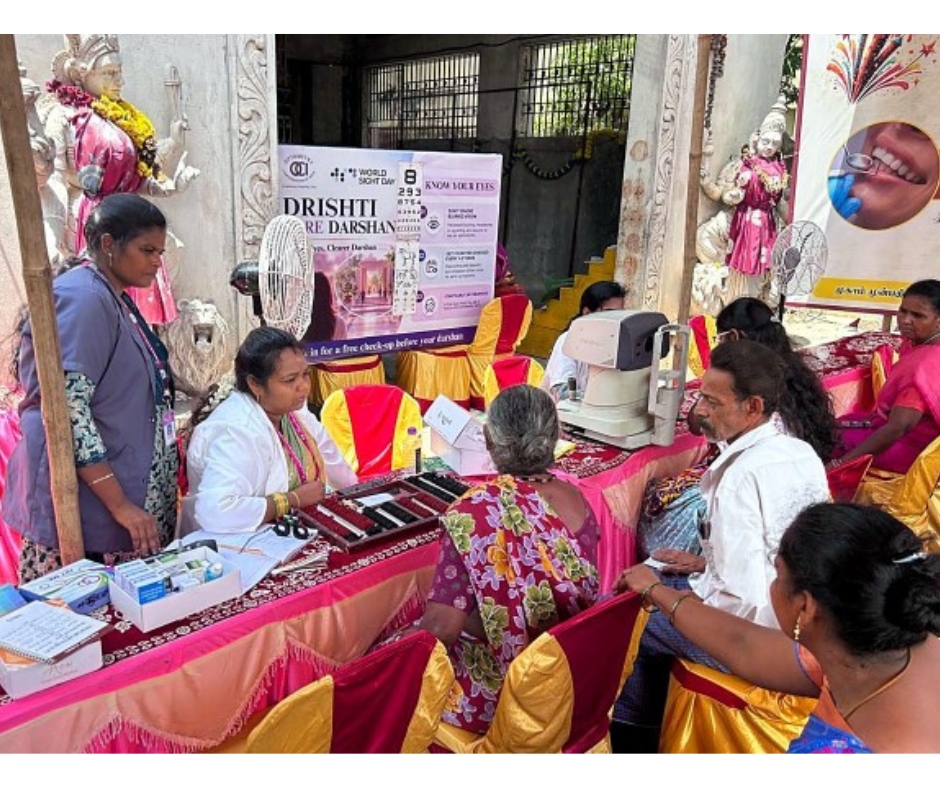
A screening camp set up at a temple, with the Drishti Before Darshan banner in the background.
WORLD SIGHT DAY 2026 · #LOVEYOUREYES
Stand outside any temple on a festival morning and watch people walk in. Some squint at the board with the timings. Some hold their phones at arm’s length. Most have never had their eyes tested, and plenty have stopped noticing that they can’t quite see.
That was the thought behind Drishti Before Darshan, OCI’s campaign for World Sight Day 2026 and this year’s #LoveYourEyes theme. The plan was simple. Instead of asking people to come to an eye camp, we would set one up where they already go.
Handing it over to the people who know their town
OCI didn’t run these camps from a central office. We asked the Unsung Heroes and Women Leaders of OCI to take them on, start to finish.
These are optometrists who see patients every day, run their own clinics and vision centres, and teach the next generation in colleges. For this campaign, they stepped into a new role. Each one picked a religious site in their own area, spoke to the people who look after it, got permission, ran the screening and sent back a report. They were organisers, field leads and reporters, all in one, on top of the work they already do.
 At a gurudwara, an elderly visitor has her eyes examined. |
 Visual assessment: a trial frame, a smile and a new prescription in the making. |
It turned out to be the right call. A neighbourhood optometrist walking into a neighbourhood temple doesn’t need much of an introduction.
The numbers

Between September 20 and October 10, 12 camps were held across Tamil Nadu, Gujarat, Karnataka, West Bengal, Uttar Pradesh, Delhi, Madhya Pradesh, Uttarakhand and Bihar. In all, 1,018 people had their eyes screened. Each camp saw between 57 and 110 people.
The venues were as varied as the places themselves: village temples, a gurudwara, a mosque, a Buddha Vihar and ashrams. The languages and rituals differed from site to site. The need was the same everywhere.
Why going to the people works
Many of the people screened would never have booked an eye test on their own. It isn’t that they don’t care. It’s far away, it costs money, and it always feels like something for next month. When the check-up is
Why going to the people works
Many of the people screened would never have booked an eye test on their own. It isn’t that they don’t care. It’s far away, it costs money, and it always feels like something for next month. When the check-up is happening in the courtyard they visit anyway, run by someone the community already trusts, that excuse is gone.
And the check-up itself is thorough. Partners carried the same tests you would expect in a clinic into the courtyard, from cover tests to retinal imaging.
 A full screening setup in a community hall: trial lenses, an autorefractor and eye charts. |
 Every visitor gets an unhurried look, and a conversation to go with it. |
 Cover test at distance. |
 Cover test at near. |
 A portable fundus camera set up at the camp. |
 The retinal image appears on the laptop within moments. |
 Vision charts in the local script, so everyone can read the chart. |
 A close look at the back of the eye. |
Thank you
To the Unsung Heroes and Women Leaders of OCI: you gave up your weekends and put your own names behind this. You made it real.
And to the temples, mosques, gurudwaras, viharas and ashrams that said yes: thank you for opening your doors.
We’d love to do this again, in more places. If you’d like to bring a camp to a site near you, write to us.


























.jpg)


.png)