Every Child Deserves Clear Vision: Strengthening Child Eye Health in Rural India
Why early detection, quality spectacles, affordability, and sustained follow-up must become national priorities.
Vision is fundamental to a child’s future.
A child’s ability to see clearly is closely linked to learning, confidence, participation, and overall development. Yet, across India, particularly in rural and underserved communities, many children experience avoidable vision difficulties because their problems remain unidentified or appropriate correction is not readily accessible.
A child with blurred distance vision may struggle to read the classroom blackboard, participate in sports, or engage fully in everyday activities. Teachers and parents may not always recognise the underlying problem.
The World Health Organization’s 2025 publication, Vision and hearing screening for school-age children; implementation handbook, reinforces the importance of identifying vision problems early and connecting screening with appropriate diagnosis, intervention, and follow-up. For India, the challenge is not merely to screen more children but to ensure that those who need correction receive safe, affordable, and properly fitted spectacles.
The rural India challenge
In many rural areas, access to qualified eye care professionals, refraction services and optical dispensing facilities is limited. Families may need to travel considerable distances for an examination or spectacles. Travel costs, limited awareness, poor fit, breakage, stigma, and inadequate follow-up can prevent successful correction.
The real measure of success is not how many children are screened, but how many children who need vision correction receive it and continue to benefit from it.
Early identification: The foundation of child eye health
Uncorrected refractive errors — including myopia, hyperopia, and astigmatism — are an important cause of visual impairment among school— age children. WHO recommends vision screening during the first year of school attendance, followed by repeat screening every one to two years. Its procedures include distance visual acuity testing at three metres under suitable lighting conditions.
A visual acuity threshold such as 6/12 guides screening and referral decisions; it is not an automatic threshold for prescribing spectacles. Children who do not meet screening criteria need appropriate assessment, potentially including refraction, cycloplegic examination, or evaluation for other ocular conditions. Screening does not replace comprehensive eye examination.
Quality spectacles are essential, not optional.
Children’s spectacles should not simply be smaller versions of adult spectacles. They require particular attention to optical accuracy, frame design, durability, comfort, and safety.
Accurate prescription and refraction by appropriately qualified professionals, with cycloplegic assessment where clinically indicated, are fundamental. Lens power, cylinder axis, centration and fitting measurements must be appropriate. Suitable impact-resistant materials, safe lens edges, stable and comfortable frames, and accessible repairs or replacement should be considered.
Quality assurance should reference relevant applicable product standards. These are supplementary professional recommendations: the WHO school screening handbook does not set detailed manufacturing tolerances for children’s spectacles.
Affordability must never mean compromising quality.
For rural families, spectacle cost matters. But affordability must not come at the expense of optical accuracy, safety, or durability. Efficient procurement, appropriate product design, local dispensing, and dependable after-sales support can help deliver quality-assured spectacles at accessible prices.
A low-cost pair that breaks frequently, fits poorly, or cannot be repaired may be less effective for the child and ultimately more expensive for the family. Comfortable, attractive frames can also encourage acceptance and continued wear.
From screening camps to sustainable vision care
India has considerable experience in school eye screening camps supported by government, hospitals, NGOs, CSR initiatives, and industry partners. The next step is continuous care: Screening → Referral → Comprehensive examination → Spectacles where prescribed → Follow-up → Continued use.
Referred children must be able to complete their examinations; prescribed spectacles should arrive promptly; and adjustments, repairs and replacements should remain accessible. Communication between parents and teachers is vital.
The important role of India’s optical industry
Lens manufacturers, frame suppliers, laboratories, and retailers collectively possess expertise in dispensing, quality assurance, and distribution.Their contribution can extend beyond supplying spectacles to suitable frame selection, accurate fitting, repairs, eplacement, and continued-use support.
Measuring outcomes, not merely activity
Programmes should monitor more than children screened or spectacles distributed. Useful indicators include referrals completed, spectacles prescribed and delivered, time to delivery, continued wear, and access to repair, replacement and follow-up.
These are proposed programme indicators informed by WHO’s care pathway approach, not a reporting framework prescribed verbatim by the handbook.
In this connection, I wish to mention Mr. Noel Tata, Chairman of Tata Trusts, recently emphasized in on e of his interviews that philanthropy should be measured by its lasting impact, not merely by the money spent or the number of beneficiaries reached. He made three important points.
1. Impact over scale — The difference it makes to people’s lives.
2. Outcomes — Tangible results rather than simple report like number of people screened.
3. Institution building — Sustainable institutions that continue serving society for generations.
A national opportunity for India
WHO SPECS 2030 offers a global framework for expanding effective refractive error coverage. India can make progress by integrating school screening with accessible professional eye care, affordable quality spectacles, and sustainable community-based services. Digital records, referral tracking and teleconsultation support can improve efficiency, but should complement rather than replace clinical examination and professional judgment.
Conclusion: Clear vision is an investment in India’s future
A pair of spectacles may appear simple, but for a child who needs refractive correction it can make a meaningful difference to everyday life and educational participation. India must move beyond episodic screening towards early detection, timely diagnosis, quality spectacles, affordability, and sustained follow-up.
Every child deserves the opportunity to see clearly, learn confidently and participate fully in life, irrespective of where they live or their family’s economic circumstances. Ensuring that opportunity reaches rural India must become a shared commitment of the eye care profession, optical industry, government, and civil society.
Reference and scope
World Health Organization. Vision and hearing screening for school-age children: mplementation handbook. Geneva: WHO; 2025. ISBN 978-92-4-010520-1. Relevant printed pages: vii–ix, 5–6, 13–18, 31–35, 43–45.
Product-quality, ISO standards, and programme performance recommendations are supplementary professional considerations, not explicit requirements of the WHO handbook.
Every Child Deserves Clear Vision: Strengthening Child Eye Health in Rural India
Why early detection, quality spectacles, affordability, and sustained follow-up must become national priorities. By P. Ramachandran Vision is fundamental ...
read more
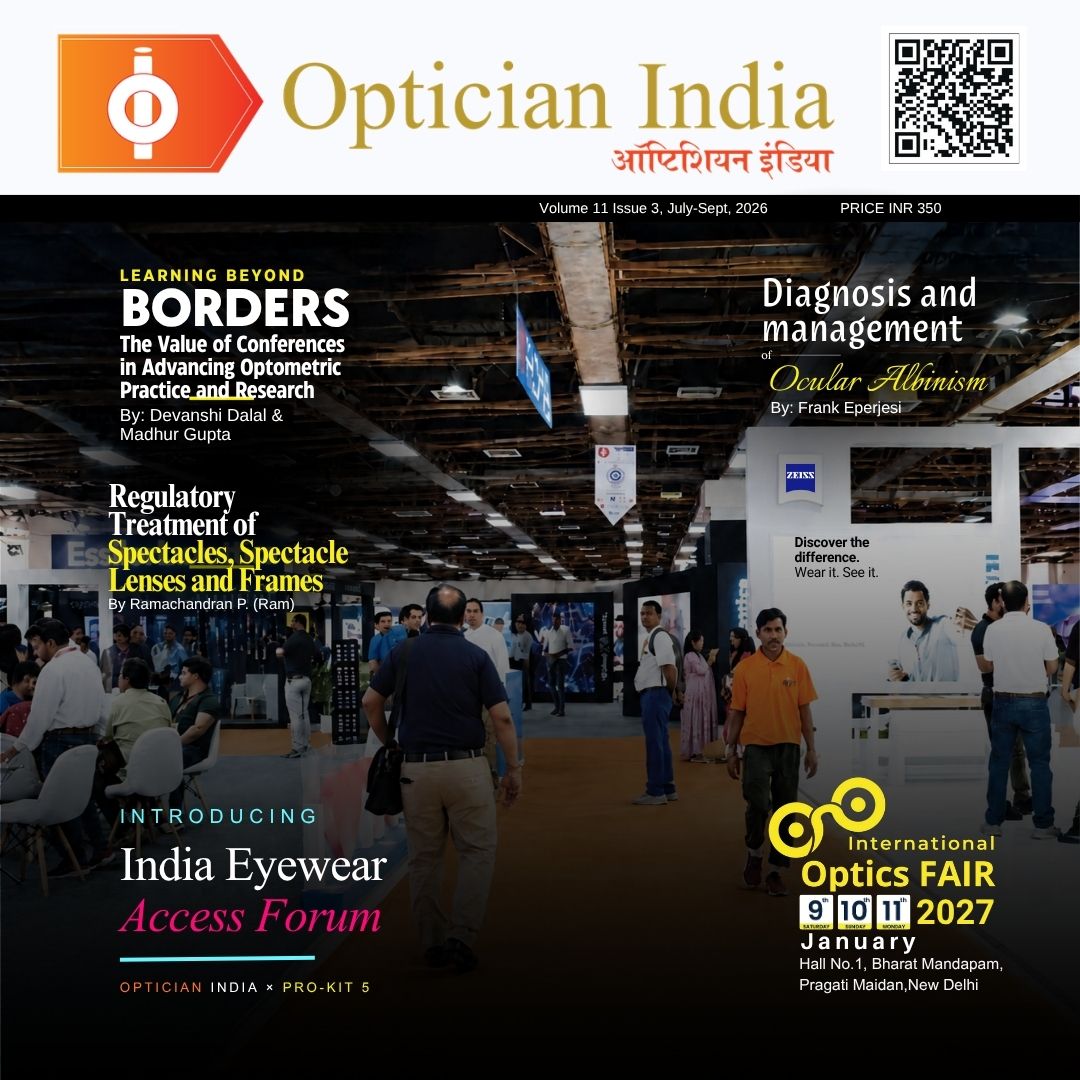
Diagnosis and management of ocular albinism
By: Dr. Frank Eperjesi Ocular albinism is very rare but if it is missed at a young age it can have devasting consequences on education, activities of da...
read more
Regulatory Treatment of Spectacles, Spectacle Lenses and Frames : Class A Exemption, Optical-Shop Dispensing and the Case for an Opticians Act
By P. Ramachandran (Ram) A Personal Industry Perspective Eyewear & Vision Care Industry Professional A discussion paper for consideration by India&...
read more
Beyond 20/20: Redefining Myopia Management and the Imperative Role of Indian Opticians
By: Vinay Swaroop Balla Navigating the 2050 Epidemiological Shift, Clinical Defocus Technologies, and the Paradigm Transition from Passive Dispensing t...
read more
37 years of specialty contact lens experience, brought to one of the most demanding ocular surface cases.
By GAGAN SAHNI Director – Professional Affairs Silverline Labs Pvt. Ltd Case Study Stevens-Johnson Syndrome : Mucous Membrane Grafting | Lid margin k...
read more












.jpg)


.png)