True luxury? Time well spent and emotion
.jpg)
In the past, "sister brands"—the segmentation of brands by major fashion houses—served to sell products to those with smaller budgets; today, however, cafés and restaurants serve to sell an identity to anyone seeking an experience. A transformation that also extends to eyewear and optical stores.
In recent years, luxury has evolved into an immersive experience, replacing the old concept of the "object of desire" with that of the "unforgettable moment." Once an exclusive, closed-door club, it is now an open public square, where the boundary between observer and owner has become incredibly fine. Even in the high-end eyewear market, brand value is no longer measured solely by the quality of the frames, but also by the quality of the experience—beyond the purchase itself—that the fashion house provides. This evolution involves both major fashion names and the leading manufacturing and distribution companies that hold market leadership.
For decades, in fact, major fashion houses adopted a consumer-oriented strategy of "sister brands"—or brand segmentation—aimed at reaching different target audiences without diluting the positioning and prestige of the high-end label. Think of Giorgio Armani with Emporio Armani, Versace with Versus, or Dolce & Gabbana with the D&G line. It was a clear hierarchy: the primary line for the elite, the secondary line for the aspirational consumer.
Today, that distinction has all but vanished. Luxury has become accessible, yet in new ways. It is a modern paradox: anyone can show off the latest iPhone by buying it in 48 convenient installments, for example, or purchase top-of-the-line eyewear—either in-store or online—with deferred payment plans. The second-hand market makes it possible to snap up an iconic handbag—or a pair of frames, whether vintage or modern—at half price. The result? Physical ownership is no longer enough to set oneself apart. Consequently, brands have had to shift their focus from the product to the sensory experience.
Reinforcing this trend is the fact that these companies increasingly choose to launch their collections in breathtaking locations, transforming product presentations into multisensory events where gourmet catering and extraordinary set designs create indelible memories. In this new frontier of experiential marketing, a culture of beauty and exquisite taste become natural extensions of eyewear culture, celebrated through a fusion of visual, aesthetic, and gastronomic pleasures.
To make brand devotion an everyday, widespread phenomenon, some fashion houses have even opened their own bars and restaurants. It is a strategy of maximum market penetration: in Milan, for instance, if you cannot afford a ten-thousand-euro dress, you can still inhabit the luxury universe by ordering a Louis Vuitton-branded pastry at the café next to the flagship store on Via Montenapoleone, an espresso at Prada’s historic Pasticceria Marchesi, or tea at Ralph’s Bar—Ralph Lauren’s own establishment.
This evolution has created a new hierarchy of consumption. Take everyday accessibility, for example: in Milan, a coffee at DG Martini (Dolce & Gabbana’s café on Corso Venezia) or an aperitivo at Justme Milano (formerly Just Cavalli)—Roberto Cavalli’s renowned restaurant, bar, and club in Parco Sempione—serve as "micro-luxury" experiences that build loyalty among younger customers. Then there is the matter of gastronomic exclusivity: dining at Massimo Bottura’s Gucci Osteria in Florence’s Piazza della Signoria can cost far more than an accessory. Here, luxury is something to be savored: tortellini in a Parmigiano Reggiano cream sauce become a narrative that fuses culinary craftsmanship with visual identity.

DG Martini (Dolce & Gabbana’s café on Corso Venezia)
In this context, these brands—which also offer eyewear collections—no longer base their commercial strategy on a specific object like a pair of glasses; instead, they validate their visibility and social standing through an Instagram post featuring a branded coffee cup. Clearly, the strategy aims to boost the value perceived by the end user, thereby positively influencing the desire to purchase within the eyewear segment. In short, it is easy to see why end consumers—particularly Gen Z and Millennials—arrive at optical stores with a specific brand identity in mind: these fashion houses have successfully cultivated a desire that transcends the product itself, staking everything on an all-encompassing experiential narrative.
Optical stores, too, are transforming into spaces for social interaction—places to cultivate experiences, rituals, culture, and emotions. For years, for instance, *Ottica made in Bo* in Acri (Cosenza) has embraced the "brand bar" concept. On the upper floor of this Calabrian shop, customers can select their frames while enjoying a cocktail and a canapé in a totally relaxed atmosphere, eliminating the stress often associated with making a choice.

*Ottica made in Bo* in Acri (Cosenza)
Then there is *Jacques Marie Mage & Geronimo Bar*, a brand born in Los Angeles that now has a presence on Milan’s Via della Spiga; it treats its niche eyewear like works of art. The link between sipping a sophisticated drink and trying on a model inspired by 1970s rock stars creates an emotional connection that a standard display shelf could never match.
A prime example of this philosophy—which humanizes a functional necessity—can be found at the entrances of the three *Jimmy Fairly* boutiques in Milan. Before even discovering the collections, customers are greeted by a welcoming, home-like invitation: "The coffee is on us—along with your eye exam." This is not merely a marketing ploy; it is genuine hospitality.
These are just a few examples; the "food-fashion" trend has impacted our sector in various ways. *Woodys Occhiali* wowed everyone with its "patisserie" collection, presenting frames atop glazed cakes as if they were edible decorations. Last spring, *Dior* displayed its eyewear alongside monogrammed cupcakes in its windows on Milan’s Corso Venezia, suggesting that the accessory is a treat for the eyes just as a pastry is for the palate.

The Dior shop window on Corso Venezia in Milan
In a world where everything can be bought on installment plans, true luxury has thus become time well spent and the emotions we experience. Sister brands of the past served to sell a product to those with a smaller budget, whereas today’s cafés and restaurants serve to sell an identity to anyone seeking an experience. And eyewear, too, is the silent protagonist of this transformation.
True luxury? Time well spent and emotion
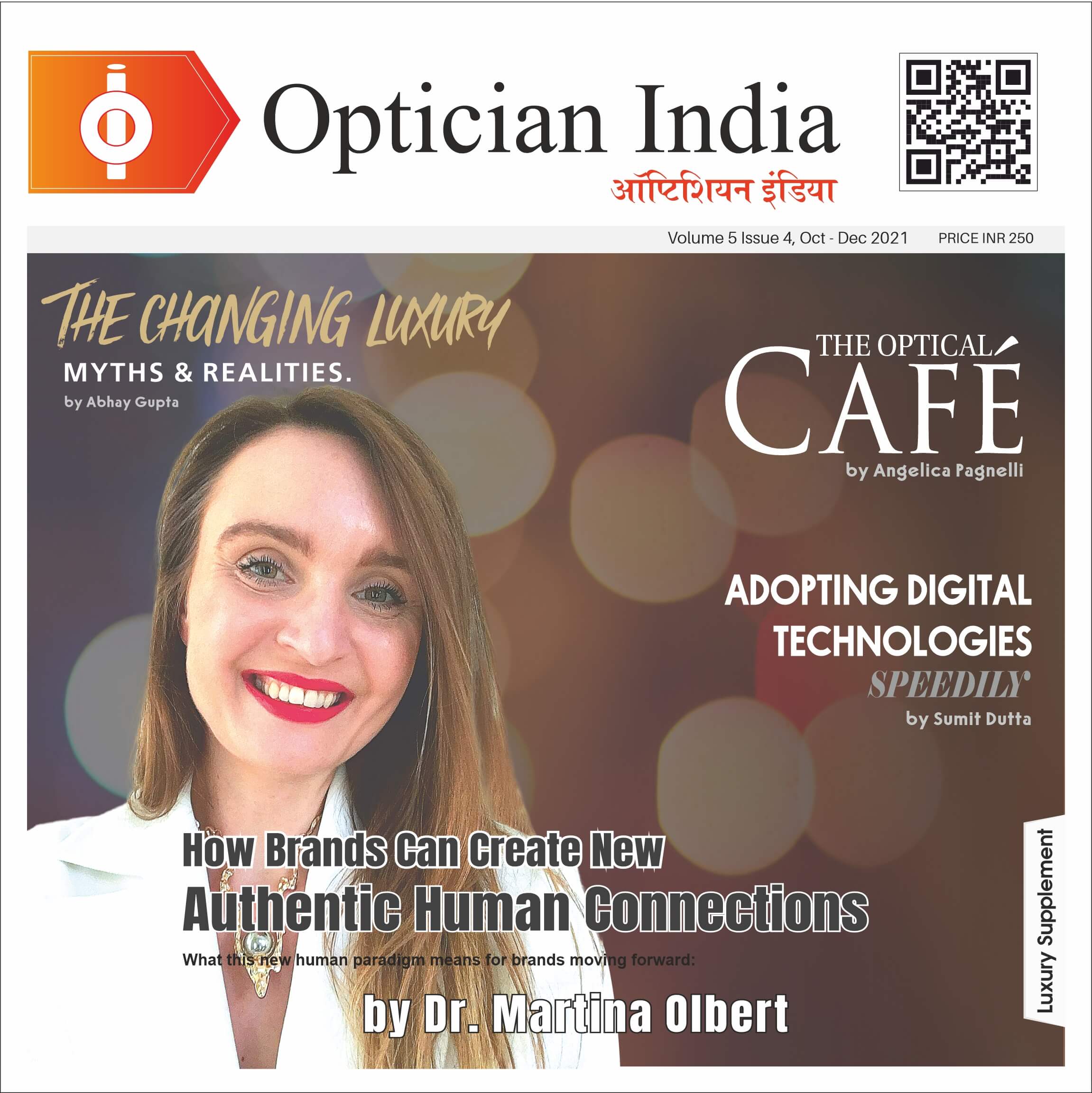
By Angelica Pagnelli In the past, "sister brands"—the segmentation of brands by major fashion houses—served to sell products to those w...
read more1.jpg)
Who Can Call Themselves an Optometrist? NCAHP May Finally Settle the Question
A personal perspective on professional standards, diploma qualifications and the future eye-care workforce By Ramachandran P. India's eye-care sector is...
read more.jpg)
Future Ready Optician: Trust, technology and the new language of luxury optical retail
By Moosi Kazmi True luxury in optics is personal accuracy. This is where the independent optician remains irreplaceable. A family returned to the s...
read more
The Future of Eyewear in India: Premiumization, Technology, and Consumer Change
Interview with Akash Goyle In this exclusive interview, Madhur Gupta, Editor, Optician India sits down with industry pioneer Akash Goyle, the former Co...
read more1.jpg)
Childhood Myopia Enters Parliament: An Opportunity for India to Act
By Ramachandran P. Childhood myopia has finally received attention at one of the country’s highest policymaking forums. On 12 August 2026, Dr. Jas...
read more.jpg)
.jpg)
.jpg)
.jpg)
.jpg)
.jpg)
1.jpg)
.jpg)
.jpg)
_(Instagram_Post).jpg)
.jpg)
_(1080_x_1080_px).jpg)
with_UP_Cabinet_Minister_Sh_Nand_Gopal_Gupta_at_OpticsFair_demonstrating_Refraction.jpg)
with_UP_Cabinet_Minister_Sh_Nand_Gopal_Gupta_at_OpticsFair_demonstrating_Refraction_(1).jpg)
.jpg)
.jpg)
.png)