The Future of Eyewear in India: Premiumization, Technology, and Consumer Change
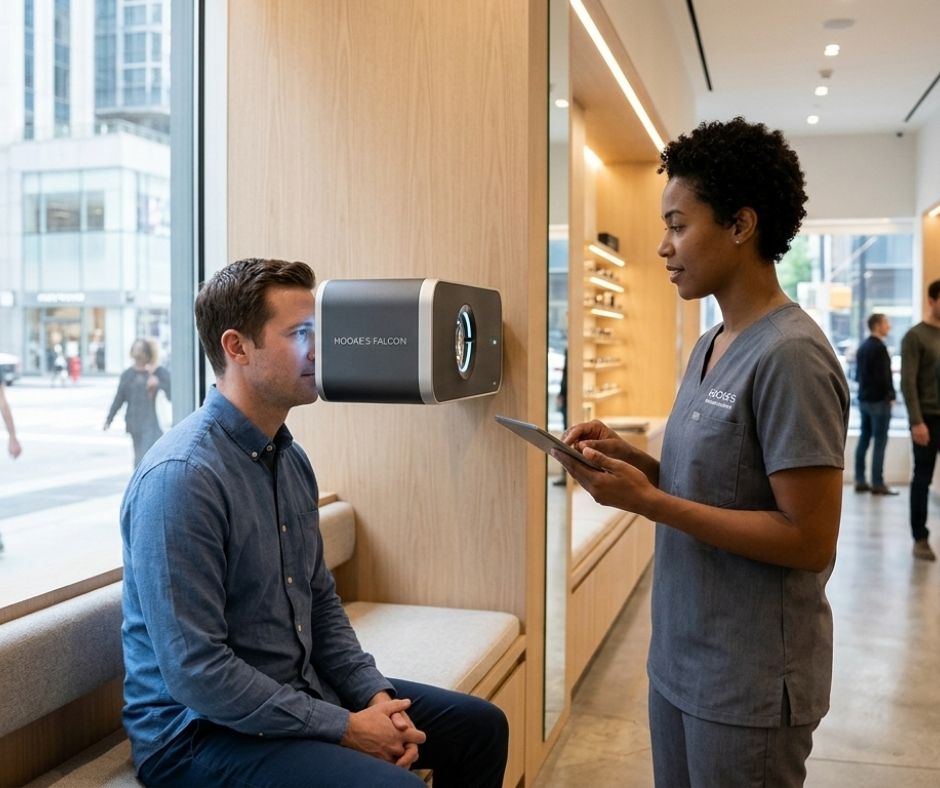
Interview with Akash Goyle
In this exclusive interview, Madhur Gupta, Editor, Optician India sits down with industry pioneer Akash Goyle, the former Country Manager and Managing Director of EssilorLuxottica India. An alumnus of IMT Ghaziabad, Akash possesses a profound, nuanced understanding of the Indian consumer—a perspective forged during his early career in FMCG and nearly a decade leading sales and marketing for top apparel brands. Transitioning into the optical sector, he became the architect of India's branded eyewear market, credited with establishing and nurturing the category's distribution networks from the ground up. Here, he shares his masterclass on how technology, shifting consumer mindsets, and premiumization are redefining the industry's future.

Akash Goyle
Madhur: Over the last decade, what's the single biggest change in how Indian consumers view and buy eyewear?
Akash: The single biggest shift is that eyewear has moved from being a hidden medical necessity to becoming prime real estate on the face. Fifteen years ago, consumers bought glasses only when their prescription changed, opting for the thinnest, most invisible frames possible. Today, eyewear is a statement of identity. It is a means to express yourself. Consumers no longer own just a pair of glasses; they build a wardrobe of eyewear for different occasions, treating frames as a lifestyle accessory and lenses as an essential tool for digital wellness.
Madhur: How do consumers in tier 2/3 cities differ from metros, and what mistakes do brands make when entering these markets?
Akash: Thanks to digital democratization and social media, the aspiration gap between metros and Tier 2/3 cities has completely vanished. A young consumer in Guwahati or Coimbatore is just as brand-aware and fashion-forward as someone in Mumbai.
The biggest mistake brands make is "under-indexing on premiumization" and dumping cheaper, lower-spec products into these markets under the assumption that they only want value. Price resistance crumbles the moment you deliver a genuine global brand experience, authentic styling, and quality. The appetite for luxury and premium products in Tier 2/3 India is massive; brands just need to treat these consumers with the same respect they show metro buyers.
Madhur: How have D2C and e-commerce changed the eyewear market in India, and where does online still fall short of physical stores?
Akash: D2C players did something fantastic for the industry: they fixed the legacy friction points. By bringing transparency to pricing, making trials convenient, dialling up the fashion quotient and catering to a younger, hyper-trendy demographic, they made the entire category "cool".
However, online retail fundamentally falls short when it comes to precise, personalized optometry and clinical trust. Eyewear is highly bespoke; it sits at the intersection of healthcare and fashion. E-commerce can provide convenience and endless scrolling, but it cannot replicate the tangible reassurance of high-end clinical hospitality, precise fitting, and the generational trust built by a physical store.
Madhur: The market is full of independent opticians. Do you expect consolidation or continued independence, and what would drive that change?
Akash: I expect a dual reality: independent opticians will continue to thrive, but only if they modernize. The independent ECP (Eye Care Professional) is the backbone of the Indian optical trade, built on deep, multi-generational relationships, providing hyperlocal access to vision care.
The driver of change won't necessarily be consolidation, but digital and operational stagnation. If independent retailers try to compete on price or basic inventory against massive chains, they will lose. But if they specialize in premium clinical care, focus on brand assortments, upgrade their store aesthetics, adopt digital inventory tools, and treat retail as an experiential destination, they will remain completely secure. As I always tell my partners: you cannot run a 2026 business with a 2006 mindset.
Madhur: How important will sustainability (eco materials, circular models) be for Indian eyewear buyers in the next 5 years?
Akash: Sustainability is shifting from a corporate checkbox to a consumer expectation, particularly among Millennials and Gen Z. These younger demographics value individuality and alignment with personal values over mere logos. They want to know the story behind what they wear. While the broader Indian market will remain highly functional, a rapidly growing, influential segment of consumers will actively choose brands that offer eco-conscious materials and ethical manufacturing. It will become a key differentiator for premium positioning.
Madhur: As India's middle class grows, do you expect the market to premiumize toward higher-end eyewear or stay focused on value and affordability?
Akash: The premium and luxury branded segment will absolutely continue to grow the fastest over the next five years. With rising per capita income, robust economic growth, and an increasingly aspirational middle class, the definition of "value" has changed. It has shifted from 'value for money' to 'value for status, comfort, and quality.' Indians have realized that since eyewear is worn on the face every single day, it shouldn’t just help them see—it defines how the world sees them. Affordability will always have a massive base, but the upward mobility toward premiumization is unstoppable.
Madhur: Which AI-powered features (virtual try-on, AI refraction, smart glasses) will have the most immediate impact for Indian consumers and retailers?
Akash: While virtual try-ons are great for top-of-funnel consumer engagement, the most immediate, profound impact will happen at the intersection of AI-driven lens customization and the evolution of Smart glasses.

On the clinical side, AI is completely transforming lens design. Traditionally, lenses were personalized using generalized demographic data. Today brands like Varilux XR, use AI algorithms to map and synthesize predictive, individual eye behaviour, enabling opticians to offer a level of bespoke visual comfort that was previously unimaginable.
The true frontier is how AI will turn smart glasses into a mainstream reality. The face is the most valuable piece of biometric real estate with speech, sight and hearing in close proximity. An eyewear powered by AI, will integrate into a consumer's digital ecosystem—transforming glasses from a simple vision-correction device into an ambient digital lifestyle assistant, a proactive health coach, a financial advisor and a lot more. For Optical Retailers, the immediate opportunity lies in preparing for this shift, evolving from traditional sellers… into technology facilitators who can guide consumers into the future of wearable AI.
Madhur: What needs to change—price, use cases, awareness, or something else—for smart glasses to move beyond early adopters in India?
Akash: Form must take precedence over function. Smart glasses are now moving beyond early adopters as technology companies have stopped building clunky gadgets for the face and instead have started partnering with optical experts to build beautiful, lightweight eyewear that ‘happens’ to be smart. The Ray-Ban Meta collaboration was a brilliant step in this direction.
The narrative now needs to move beyond a social/media consumption tool to a digital assistant proving everyday convenience. The ‘use cases’ need to expand and integrate into our daily life. The technology companies and developers will play a big role here. The adoption is bound to skyrocket. We have seen this happen in the smartphone category.
Madhur: Which human skills in selling and fitting eyewear are irreplaceable by AI, and how will AI realistically augment opticians' work?
Akash: Empathy, styling, and clinical hospitality are entirely irreplaceable by AI. An algorithm can calculate data, but it cannot understand the nuance of a customer’s self-image, how a frame makes them feel, or style a frame correctly to a unique face shape.
AI will realistically augment opticians by acting as the ultimate co-pilot. It will take over the heavy lifting of data synthesis, inventory optimization, appointment management, and predictive vision tracking, freeing up the optician to do what humans do best: build deep relationships, offer expert clinical consultation, and provide a premium, high-touch experience. Technology is only as good as the person using it.
Madhur: If you were building an eyewear brand in India for the next 10 years, what 2-3 strategic bets would you make?
Akash: First, I would bet heavily on the premiumization and technology intersection. I firmly predict that in the coming decade, a massive portion of the frames sold will be smart glasses, with a significant number featuring smart lenses. I would build a go to brand that democratises tech and AI for the millions of aspirational Indians.

Second, I would bet on "Handmade in India" premium Independent eyewear brand. India has been celebrated for its craftsmanship and artisans for centuries. It is high time an independent, niche storytelling eyewear brand emerged from India to feature prominently on global stages like MIDO and SILMO.
Finally, I would invest aggressively in frontline retail talent. You can have world-class store designs, but if your frontline team cannot seamlessly articulate advanced lens technology or curate a personalized style, the business cannot scale. Retail is detail, but leadership will always be about relationship and human respect.
.jpg)
True luxury? Time well spent and emotion
By Angelica Pagnelli In the past, "sister brands"—the segmentation of brands by major fashion houses—served to sell products to those w...
read more1.jpg)
Who Can Call Themselves an Optometrist? NCAHP May Finally Settle the Question
A personal perspective on professional standards, diploma qualifications and the future eye-care workforce By Ramachandran P. India's eye-care sector is...
read more.jpg)
Future Ready Optician: Trust, technology and the new language of luxury optical retail
By Moosi Kazmi True luxury in optics is personal accuracy. This is where the independent optician remains irreplaceable. A family returned to the s...
read moreThe Future of Eyewear in India: Premiumization, Technology, and Consumer Change
Interview with Akash Goyle In this exclusive interview, Madhur Gupta, Editor, Optician India sits down with industry pioneer Akash Goyle, the former Co...
read more1.jpg)
Childhood Myopia Enters Parliament: An Opportunity for India to Act
By Ramachandran P. Childhood myopia has finally received attention at one of the country’s highest policymaking forums. On 12 August 2026, Dr. Jas...
read more.jpg)
.jpg)
.jpg)
.jpg)
.jpg)
.jpg)
1.jpg)
.jpg)
.jpg)
_(Instagram_Post).jpg)
.jpg)
_(1080_x_1080_px).jpg)
with_UP_Cabinet_Minister_Sh_Nand_Gopal_Gupta_at_OpticsFair_demonstrating_Refraction.jpg)
with_UP_Cabinet_Minister_Sh_Nand_Gopal_Gupta_at_OpticsFair_demonstrating_Refraction_(1).jpg)
.jpg)

.jpg)

.png)