Should You Prescribe Contact Lenses to Children?
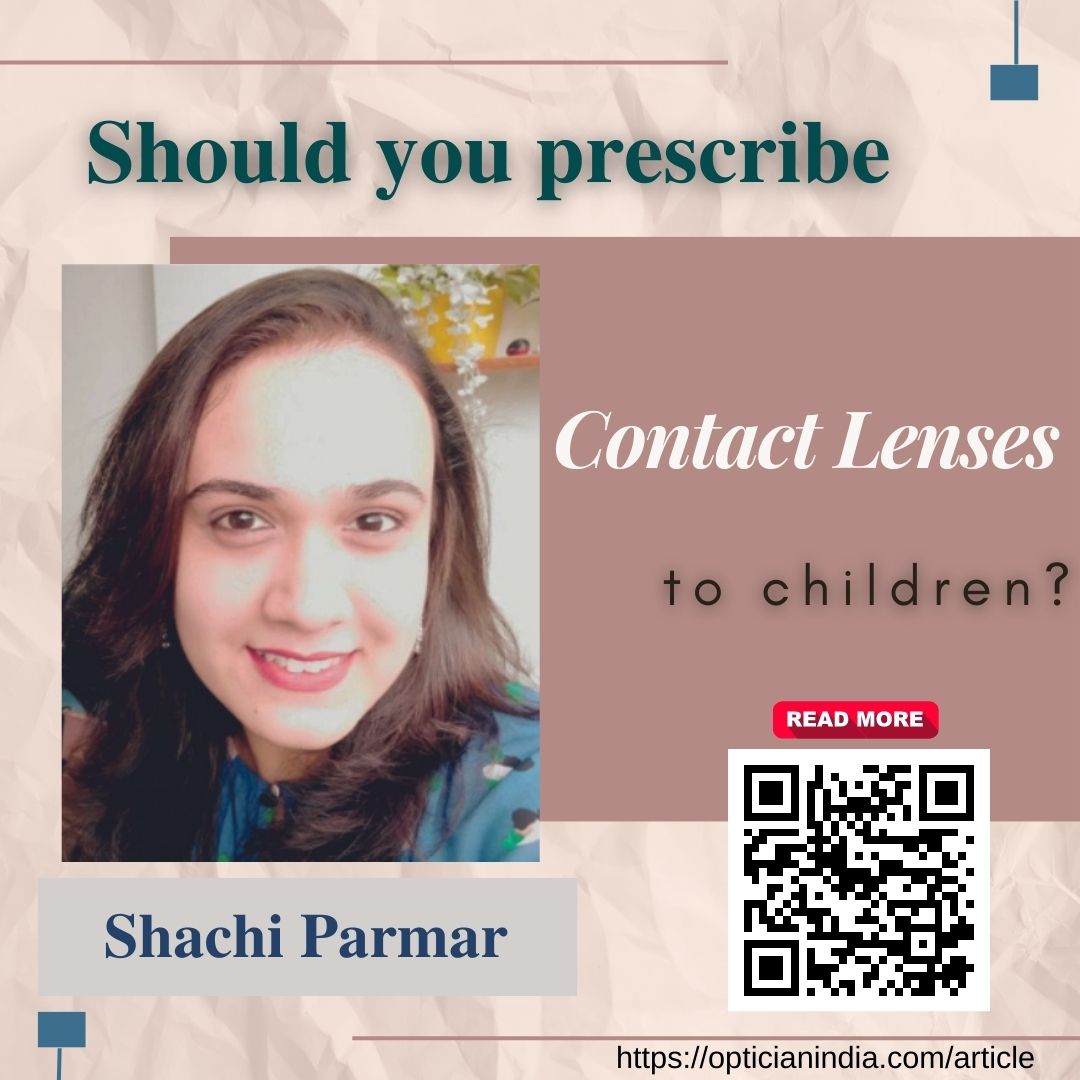
The eye is a sensitive organ and the subject becomes even more acute when it comes to the eyesight of children. Whether you are an OD prescribing Ortho K lenses or you are an optician selling over-the-counter eyewear to children, you take extra caution for your little patients. I’m sure you agree with this, don’t you?
Although Orthokeratology is not new, in India, prescribing contact lenses to kids is not a common practice. However, let us answer some common concerns of parents so you can be more confident while dispensing contact lenses.
*Can a child’s eye tolerate contact lenses?
Children as young as infants are prescribed contact lenses in situations where they have eye conditions like cataracts at the time of birth or other such conditions. So, yes children’s eyes do tolerate contact lenses at a very young age.
*What is the best age to wear contact lenses for children?
Another, commonly asked question by parents is what is the right age for kids to start wearing contact lenses. Now, as mentioned before, contact lenses can be worn even by infants but you need to look into other factors such as the activities they do throughout the day, how responsible they are about their things, hygiene, and personal wellbeing. Generally, children aged 8 or above are capable of handling contact lenses independently but it may vary in children.
*Are children able to follow the contact wearing and maintenance lens guidelines?
Children are fast learners and proudly take the responsibility of wearing contact lenses correctly. They tend to adapt faster and follow instructions better than adults. Additionally, very few children have a condition of dry eye in which contact lenses are not suitable. Consequently, they face less difficulty in wearing contact lenses.
*Are contact lenses suitable for children playing any sport?
The eyeglasses of children playing sports are prone to breakage and are often a concern of parents. Even if you dispense PC (Polycarbonate lenses), frames are still fragile Further, there is also a possibility of causing eye injuries in case of eyeglass breakage.
Contact lenses for sport-playing kids are a great alternative. They offer added benefits such as visual clarity even in the periphery that in turn improves their performance in their game. They also fit perfectly on their cornea and stay in place even during physical activity as you already know.
*Are contact lenses effective in myopia control?
_(1).jpg) |
_(2).jpg) |
Multi-focal
According to a clinical trial funded by National Eye Institute, it is studied that “children wearing multifocal contact lenses had slower progression.” The only FDA-approved contact lens for myopia correction is the MiSight multifocal lens (CooperVision).
MiSight is a daily-use disposable lens with a +2.00 D center distance and concentric peripheral rings. By decreasing peripheral hyperopic defocus and increasing peripheral myopic defocus, these specific contact lenses impede the progression of myopia. A recent randomized clinical experiment showed that wearing MiSight for three years could delay the progression of myopia and axial elongation by 59% and 52%, respectively, compared to wearing single-vision contacts.
Ortho-k
Overnight ortho-k lenses are made of a rigid gas-permeable material and are used in orthokeratology or corneal reshaping therapy. To create a focused image on the fovea and to clear incorrect daytime vision, they momentarily flatten the cornea. It is studied that this technique reduces axial length elongation by 30% - 80%. Recent studies suggest that ortho-k may also be helpful for cases of higher myopia and anisometropia.
*Are there any chances for allergies?
There pertains a risk of microbial infections however, you need to educate parents about contacting an eye doctor in case any redness, irritation, discharge, or other symptoms are experienced. You must also coach them and the children on proper contact lens handling methods.
On an ending note, placing something in a child’s eye raises a lot of questions in the minds of their parents. However, I have tried to answer a few in this article but you need to be prepared for more.
Above all, contacts help boost self-esteem in children while improving visual clarity. Hence, dispensing contact lenses to children where required need not be overthought but should be done with extra care.
.jpg)
True luxury? Time well spent and emotion
By Angelica Pagnelli In the past, "sister brands"—the segmentation of brands by major fashion houses—served to sell products to those w...
read more1.jpg)
Who Can Call Themselves an Optometrist? NCAHP May Finally Settle the Question
A personal perspective on professional standards, diploma qualifications and the future eye-care workforce By Ramachandran P. India's eye-care sector is...
read more.jpg)
Future Ready Optician: Trust, technology and the new language of luxury optical retail
By Moosi Kazmi True luxury in optics is personal accuracy. This is where the independent optician remains irreplaceable. A family returned to the s...
read more
The Future of Eyewear in India: Premiumization, Technology, and Consumer Change
Interview with Akash Goyle In this exclusive interview, Madhur Gupta, Editor, Optician India sits down with industry pioneer Akash Goyle, the former Co...
read more1.jpg)
Childhood Myopia Enters Parliament: An Opportunity for India to Act
By Ramachandran P. Childhood myopia has finally received attention at one of the country’s highest policymaking forums. On 12 August 2026, Dr. Jas...
read more.jpg)
.jpg)
.jpg)
.jpg)
.jpg)
.jpg)
1.jpg)
.jpg)
.jpg)

_(Instagram_Post).jpg)
.jpg)
_(1080_x_1080_px).jpg)
with_UP_Cabinet_Minister_Sh_Nand_Gopal_Gupta_at_OpticsFair_demonstrating_Refraction.jpg)
with_UP_Cabinet_Minister_Sh_Nand_Gopal_Gupta_at_OpticsFair_demonstrating_Refraction_(1).jpg)
.jpg)

.jpg)

.png)